
DIABETES AND WOUND HEALING…
Diabetes (a disease in which patient suffers complication from high blood glucose levels) is known to heal wounds more slowly, there by raising the risk of developing an infection over the wound and leading to other complications.
This article details the factors responsible for such wounds (with illustrations) and tips for keeping ourselves healthy and wound free.
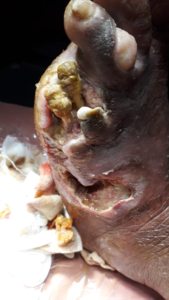
Small cuts, minor wounds, burns and bruises are very common in life, but even such small aberrations can cause serious life threatening health issues in diabetic patients (as in image 1).
In terms of wound healing it can either be a healing ulcer or a non healing ulcer. Non healing ulcers or delayed healing ulcers can become infected, those infections can spread locally, to the adjacent tissue causing necrosis or gangrene, and to the bone to cause osteomylitis and/or can even mix in blood stream to cause septicemia, in such cases, they may even be fatal.
There is a clear cut proportionality between blood glucose levels and wound healing. The higher the blood sugar the difficult it is to heal a wound. Like a vicious circle higher blood sugar causes delay in wound healing like wise – more the infection, higher the blood sugar levels.
So the ultimate key for a better wound healing is strict diabetic control. To further understand the cause and methodology of wound causation the table below will throw light on the key factors involved in wound formation and healing.
DIABETES AND WOUND:
The ability of the body to fight against bacteria and its growth is impaired by chronic increase in glucose levels. Higher glycemic levels are associated with poor circulation as a result of slow moving of red blood cells, which makes it difficult for the body to deliver nutrients to the affected site, thus delaying the healing process or may even render it non healing.

The other important factor is the nerve damage which occurs concomitant with diabetes. Nerve damage is termed as “neuropathy” which reduces the sensation of the feet hence making it vulnerable for injuries or trauma and make it unnoticed. This particular phenomenon is very common now a days, which prevents the patients from seeking treatment at the right time, and there by allowing the wound to become even worse.
Other common ailments that might increase the risk of infection are dryness, cracks in the skin, toenail infection and foot deformities etc.
Ill fitting foot wears also play a major role in causing ulcers and aberrations that might get infected later on, if left unnoticed or untreated.
Example: Case 01:
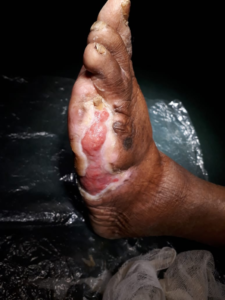
A 67 yrs old female came with a pin prick in the sole of the left foot which was left unnoticed for over 7 days.
The first image shows the condition of the foot when she came to our hospital first on 17/11/2018. She was advised for amputation initially for 4 fingers then when the wound got worse she was advised for partial amputation of the fore foot. she was referred to our hospital for conservative management. The results are shown below.
Before treatment:
After treatment:
PREVENTION:
Maintaining good foot hygiene by washing and moisturizing daily may help to promote wound healing.
Proper foot care includes:
- washing feet daily
- Seeking medical help immediately when any ulcers or injuries are noted.
- patting dry and applying moisturizing lotion
- avoiding walking barefoot
- carefully trimming toenails
- wearing comfortable shoes
- inspecting feet and looking inside shoes daily
- Regular foot examination at the local clinics.
CONCLUSION:
Any slow healing wound can quickly become life-threatening, so, prompt wound care and proper treatment regimen is ideal in saving the parts from being amputated.
It advised to contact a doctor immediately,
- when the patient develops a painful wound
- if the wound appears infected – with foul smelling discharge
- if the wound is looking dirty and covered with dirty coloured slough
- if heat and redness is noted in the surrounding area
- if the patient has persistent or on and off fever.
Treatment of diabetic ulcer combines a proper and exceptional wound cleaning, progressive and aggressive medical management, surgical intervention if needed in case of wound débridement and positive glucose control. Amputation should be held as the last resort if all the other methods fails.


Leave a comment